


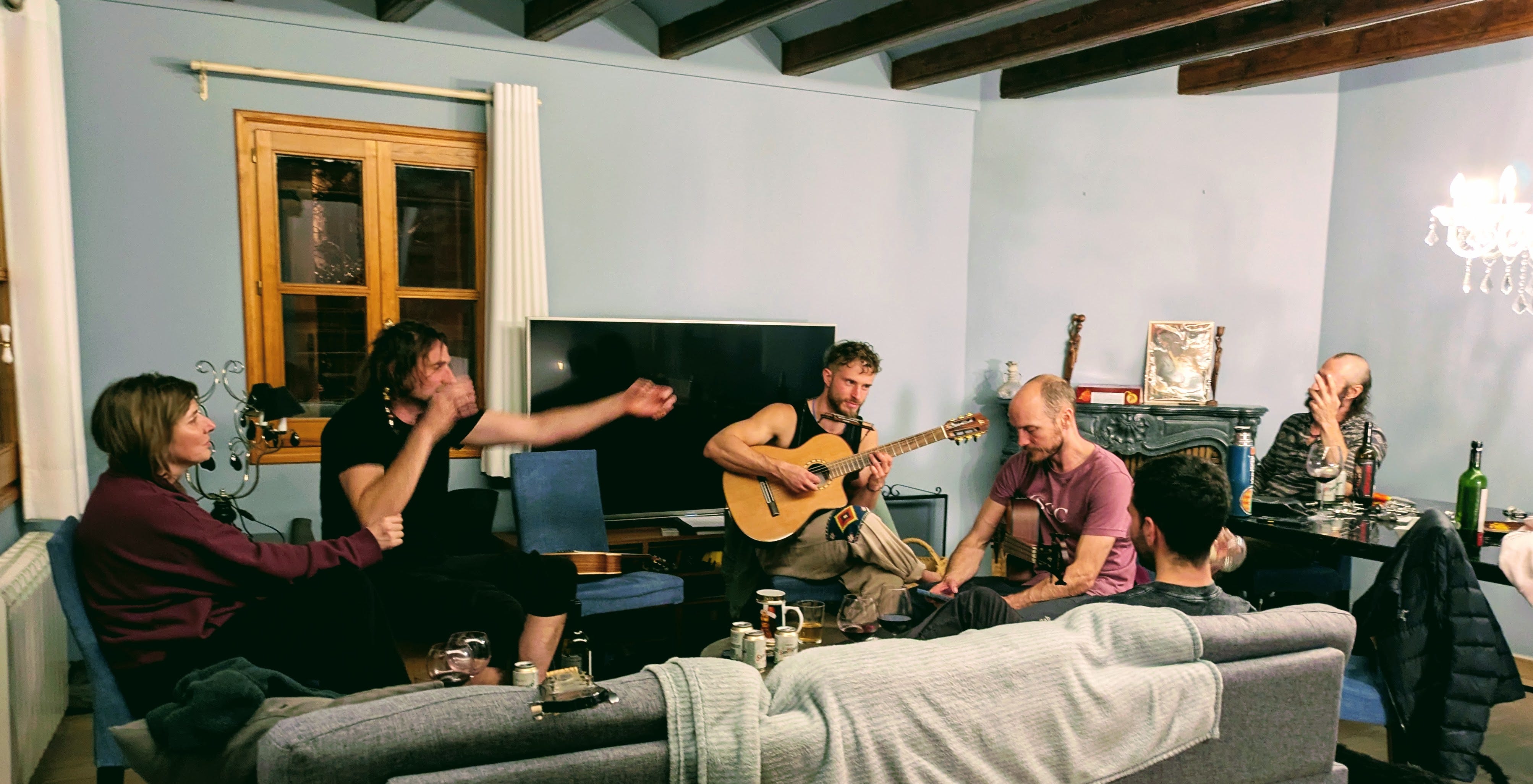
It was last winter in Arbolí, around a fireplace in a stone home in the mountains of Catalunya, that I realized I was enjoying good wine and company with three retired or close to retired, quite wealthy men in their 40s whose work all shared something in common—three dudes who you would never have guessed, but were rich in most of the ways that others aspire to be.
You wouldn’t have guessed, because all three of them appeared to be stereotypical dirtbag climbers. They wore used clothing with holes, their hair was greasy with dreadlocks, and they walked most places in cheap plastic crocs. (“If you can’t croc it, fock it!”)
The bottles of wine cost a handful of euros. The food on the table was simple. And their idea of a good life was exactly what we were doing at that moment: laughing at each other’s silly jokes, playing music, and having a drink and a good meal after a long day of climbing.
All three of these guys were millionaires, or close to it. And all three had many months out of each year to pass their time however they chose (and what they chose was usually climbing).
But it was the shared, simple, totally straightforward nature of their work that had just suddenly occurred to me:
An owner of a stove shop
A tree-trimmer
A landscaper
The owner of the stove shop sold wood stoves in the mountains of New Hampshire. People will always need to heat their homes, he was fond of saying. He’d built the business from one truck and a small list of clients into a store that now employed half a dozen people and did over a million in annual revenue.
The tree trimmer, who worked part of the year and also employed a small team, had something similar to say about his own business: people will always pay to protect their houses.
It was the same for the landscaper, who had just sold his business to his employees and was effectively retired in his early 40s. The business specialized in landscaping for flood mitigation, also to protect people’s homes.
Three guys. Three small business owners. Three wealthy, retired or close-to-retired dirtbag climbers.
One of them even had a PhD. (Which one? It doesn’t even matter; education clearly wasn’t an indicator of anything in this room: one didn’t finish high school; the other studied engineering at a state school). The one with the PhD had published a novel and also wrote a politics column for the local newspaper. Another had bolted hundreds of new climbing routes on land he owned near Chattanooga, Tennessee.
Each was leaving a legacy and contributing to their community beyond just their work, as if employing others to feed their families and providing critical services to homeowners weren’t enough.
For a moment, that evening, we all debated capitalism—an economic system that large swathes of society, mostly in wealthy nations, have decided is an evil curse that should be abolished. Of course, these guys didn’t share that view.
The more interesting, more difficult debate was about AI, and it stretched long into the evening, past several bottles of wine and cans of beer. The tree trimmer insisted it would destroy all that we hold sacred and dear in life, especially as it pertained to art, writing, music. I countered that, while it might hollow out the mediocre middle of many areas, it was a tool we would all nevertheless be wise to learn and get used to.
At least, that’s what I remember of that debate. It was a lot of bottles of wine.
Nine months later, I still think of these three guys every time I read something online about how to succeed in business, or how digital nomads make their money, or I encounter a new screed against the ism which shall not be named. I think of them when I read about how the world is changing so rapidly it will be difficult to keep up. Or when I see another prediction of widespread job loss because AI can now write code. I think of them when I hear a young person complain that it’s impossible to succeed in this economy, in this environment, in this dark, terrible, complicated world.
People will always need to heat their homes. Protect their homes. Take care of their families. Feed and clothe their kids. Look after their elders.
One of my marketing clients has a common refrain: simple, but not easy.
He’s an integrative medicine physician, and I often think of him as well. As a kid, he worked on his parents’ alcohol distribution company, loading and unloading cases of beer from trucks as they drove around Maryland. Now, in addition to practicing medicine, his family runs a farm, where his own kids have worked and contributed.
He’s always saying that your health, longevity, well-being—whatever you want to call it—comes down to doing the simple things in life. Eat healthy food, get good sleep, move your body often. Don’t drink too much, don’t smoke. Simple, yes. But not easy.
Like most important things in life, it’s not complicated, but it is hard.
And that’s what I think is actually stifling most people. First, they get distracted, so they don’t realize that what they’re trying to do is actually a simple thing, despite the billion-dollar industries intent on convincing them otherwise.
But second, they feel it’s just too hard. It’s hard to decide how to spend your time on this earth. Loading and unloading cases of beer all day is hard. So is working on a farm, and tree-trimming, and installing wood stoves, and shoveling dirt. Raising kids is hard. And so is gardening, brewing, plumbing, carpentry, caretaking, and most other things done with your body.
But these are also things we’ve needed to do for thousands of years, and which aren’t going away. (There are also things that I hope would go away, but haven’t yet: fighting wars or fires, protecting communities against crime).
For my part, when the robots finally take my marketing job, I plan to go to the nearest bar and start pouring drinks. I’ve bartended occasionally in the past, here and there—I enjoy the simplicity of it.
I’ll spend less than I earn, and use the rest of the time for doing the things important to me: climbing, writing, learning, and spending time with the people I love.
Simple but not easy is good reminder for almost anything in life. Only partially related, but another one I love is: you always have more time than you think, even though you don't have much time. Rarely do you ever need to act instantaneously, and even 30 seconds of thought often yields better results. This became very clear to me when I started dinghy sailing for the first time, where things seem to go wrong much faster than on a heavy keel boat, like the ones I learned on. I'd watch the best sailors at my club who seemed to move sluggishly, yet perfectly through tacks, jibes, etc and realized that in my effort to act fast, I'd introduce unnecessary error
So much here that is true. Reading this during a break from gardening and cutting off dead wood from an apple tree in the autumn sun. My wife out with me pruning overgrown plants. Nowhere else I’d rather be right now.