


Epically long limestone cliffs, orange and black streaks on grey rock, towering overhead, winding past steep rock caves the size of aircraft hangars, views of the Spanish Pyrenees in the distance.
I thought the hike might clear my head, as they often do. Contact with nature, lactic acid in the legs, my black cockapoo trotting off ahead and running back to check on me—I thought all of this might bring some clarity.
My body felt heavy. My mind, worse. Seeking out risky behavior. Feeling nihilistic, unmotivated, creatively adrift.
I peeled down through the abandoned ruins of a once-idyllic village, terraced hillsides long-since abandoned, then climbed again past a series of gigantic, shark-fin-like rock formations jutting out into the Mascún canyon. Dozens of them, one after the other. Rock searing its way into the empty canyon space, inspiring, at least for a moment, some sense of awe.
Awe: from the old Norse word for ‘fear’ or ‘dread.’
What would it be to climb one of those shark fin rock pillars? I wondered. Climbing, the only thing I could always do when nothing else was working.
Back at camp I sat in my hammock and picked up the book I’d been devouring. The Man Who Quit Money. A man who managed to live as the title says, and astonishingly well.
Some win the games society sets before us: leader of a successful company, pillar of a community, a sports champion of some kind. Wealth, status, achievement, maybe a trophy spouse and a cool car. Some even win these games by finding unconventional methods, by ‘thinking differently,’ or being in some sense counter-cultural.
But I’ve been making a study recently, ongoing, of a different kind of person, who appears to me extremely rare. These invent their own games. They are somehow able to put aside every societal expectation or mimetic draw, regardless of source: parents, upbringing, spouse, community, society.
These are people who somehow see something they want to do with their one wild and precious life, and devote themselves to it, conventional measures of success, meaning, or purpose be damned.
“My life is over, and it’s been a good one,” says Jan Conn in the new documentary Chasing Pinecones. “I’ve got no regrets. And there isn’t really anything that I would like to do that I haven’t done.”
Jan and her husband Herb spent nearly their entire life either living out of an old jeep so they could travel and climb, and later out of a makeshift hut carved into a hillside, no running water or electricity. Up until their death (Herb in 2012 at age 91; Jan at age 99 in 2023), they worked as little as possible so they could spend their time climbing, exploring, and doing whatever else struck their fancy.
Jan wrote music and played dozens of instruments. Herb worked on difficult math problems and corresponded with people all over the world. Together, they mapped more than 60 miles of cave at Jewel Cave in South Dakota (which took them 20 years and more than 700 trips underground), as well as established more than 200 first ascents of now classic climbs in the Needles.
“Herb and I did the things we wanted to do. We put them first, and I’m glad we did that,” says Jan in the documentary.
If only it were that simple.
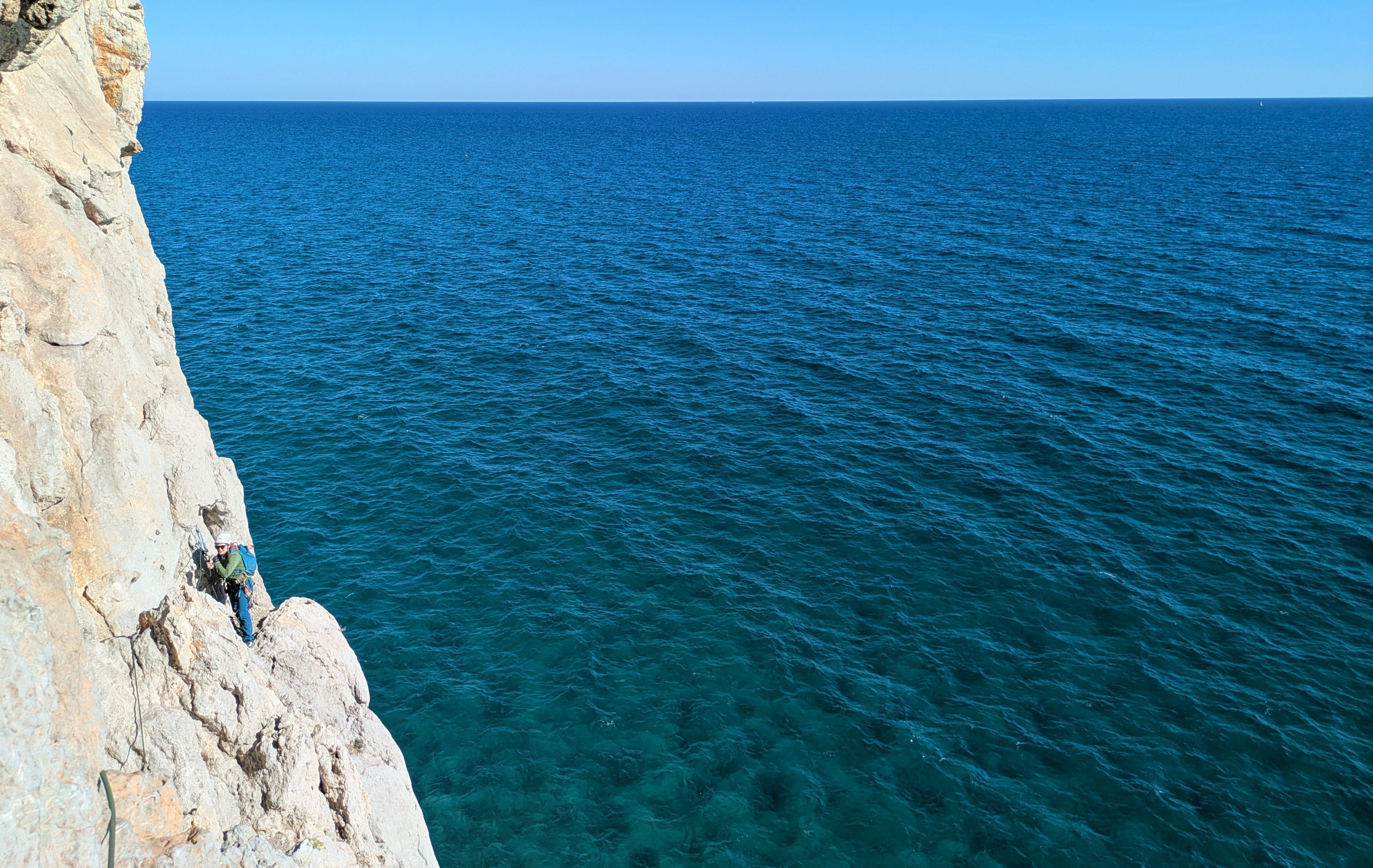
Dani descends first. It’s a vertical cave over the Mediterranean, a little more than 60 meters high. It takes two rappels for us to get down—most would consider the descent itself sufficient adventure for the day, but Dani and I are using it to access Via Chani, a five-pitch classic that climbs blocky limestone 145 meters over crashing waves.
I want to move fast and light, to see how efficiently we can ascend vertical rock, gear hanging from our harness, water and approach shoes in the single backpack we trade off between pitches.
She offers me the harder pitches, and I see how long I can climb before placing another piece of gear. It’s an easy climb for me, so I can stop and appreciate the setting. Perched hundreds of feet above the sea, Fall breeze in the air, Garraf harbor below us, sailboats and kayakers navigating in and out.
There are two committing moves, one a diagonal traverse up an exposed ramp, the other a hard pull on crimps from a ledge. I wonder to myself if I would do them without a rope, free solo style. No gear, no harness, no climbing partner. Just me, my climbing shoes, and a small bag of chalk hanging from a thin band around my waist.
Would I?
I finished the book about the man who quit money and drove back to my apartment in Barcelona, happy for the distraction of climbing and time with old friends.
Yet as I settled back into the European dream, the good life, a way of life many would dream of, a certain familiar emptiness crept back. As if climbing was increasingly the only time I could push these questions away: what comes next, what is it all for? All else but the rock was beginning to feel like existential dread.
In my apartment, I finished another book, The Stranger in the Woods. If the man who quit money was guided by a deeply held belief system going back to the Bible, the subject of Stranger in the Woods appeared to have emerged from his 27 years alone in the Maine woods with no insight or wisdom at all. Nothing to say about life, love, or purpose.
He had simply wanted to be alone, he insisted repeatedly to his biographer.
“The more you realize, the more you realize there is nothing to realize,” says Tenzin Palmo, a Western woman who became a Buddhist nun, and who spent 12 years living alone in a cave in the Himalayas, meditating in solitude the entire time. “The idea that there’s somewhere we have to get to, and something we have to attain, is our most basic delusion.”
I put the book down and felt a sinking feeling in my gut. All that meditation and solitude, underpinned by a 2,500-year-old spiritual practice that I identify with, and that’s it?
All the enlightenment in the world doesn’t remove certain basic challenges. So why chase it? Why ask the questions at all? When asked about why she did what she did with her life, Jan Conn seemed to feel the question was a bit silly—they just tried to do what they thought was fun.
I’ve met people like her. Those with some intuitive sense guiding how they choose to spend their time on this Earth. I envy them. When asked to explain their biggest life decisions, they rarely have anything particularly deep. I just felt like that’s what I wanted to do. Or, I try to do what I find interesting.
Jan Conn again: “You can’t just set out and say, ‘well, I’m going to make a contribution to the world.’ You’ve got to follow your own desire and do it with all your heart. And if you want to do it, it has value. And I’ve found that if you follow your own desires, you end up making a contribution.”
But it’s far from obvious that one follows the other. The man who spent 27 years alone in the Maine woods most certainly did not make a contribution (in fact, he subsisted by stealing from nearby cabins). If I simply climbed from now until the end of my days, I’m honestly not sure what kind of life that would be.
Despite the world’s wisdom at my fingertips, I still suffer from that basic delusion. The need to attain something. To go somewhere.
Montgrony, foothills of the Pyrenees.
Kevin and I climb El Pou de Les Bruixes after the two-hour drive from Barcelona. Seventy meters of casual limestone, IV+. Not hard, nothing that feels committing. In the evening, we stay in the local refugi, eat a traditional Catalan meal, and share a half liter of the local wine.
The next day we climb Tardor, 105 meters, four pitches of ribbed slab, 5+. I’m on lead, tiptoeing my way up the rock, Kevin feeding out the rope from below. At the top, we snap a selfie before trotting down the forest path back to the base.
But I still had pent-up energy. Some restlessness deep inside.
I leave my harness and a pile of quickdraws and my water and tell Kevin I’m going to repeat El Pou de Les Bruixes. No rope? he says. No rope, I say. Don’t die, he replies.
At the base of the cliff, I feel nervous energy. I’m pulling on huge holds, but there’s a reality here I’ve never exposed myself to, ever. After a few moves, when I’m high enough for it to matter, I pause to check in, calm my heart, and start to appreciate what it is I’m doing.
I start again, each hand and foot deliberately placed, each hold tested. Even if a shard of rock were to break free (very unlikely), I am climbing in such a way as to never rely on just one limb.
At the top of the first pitch, I yell down to Kevin where I am, just to give him some reassurance, and I hear a faint call back confirming he heard me. And then I continue up. I’m breathing easy, not expending a lot of energy, just climbing, and only air below.
Once at the top, I fetch my phone from my pocket and check the time. The day before, roped, it had taken us an hour. Today, eight minutes. The climb had taken me eight minutes. Eight minutes that was better than any drug I’ve ever taken, real or imagined. I’m not sure any essay can truly describe it.
I yell down that I’m at the top, and I hear another faint reply.
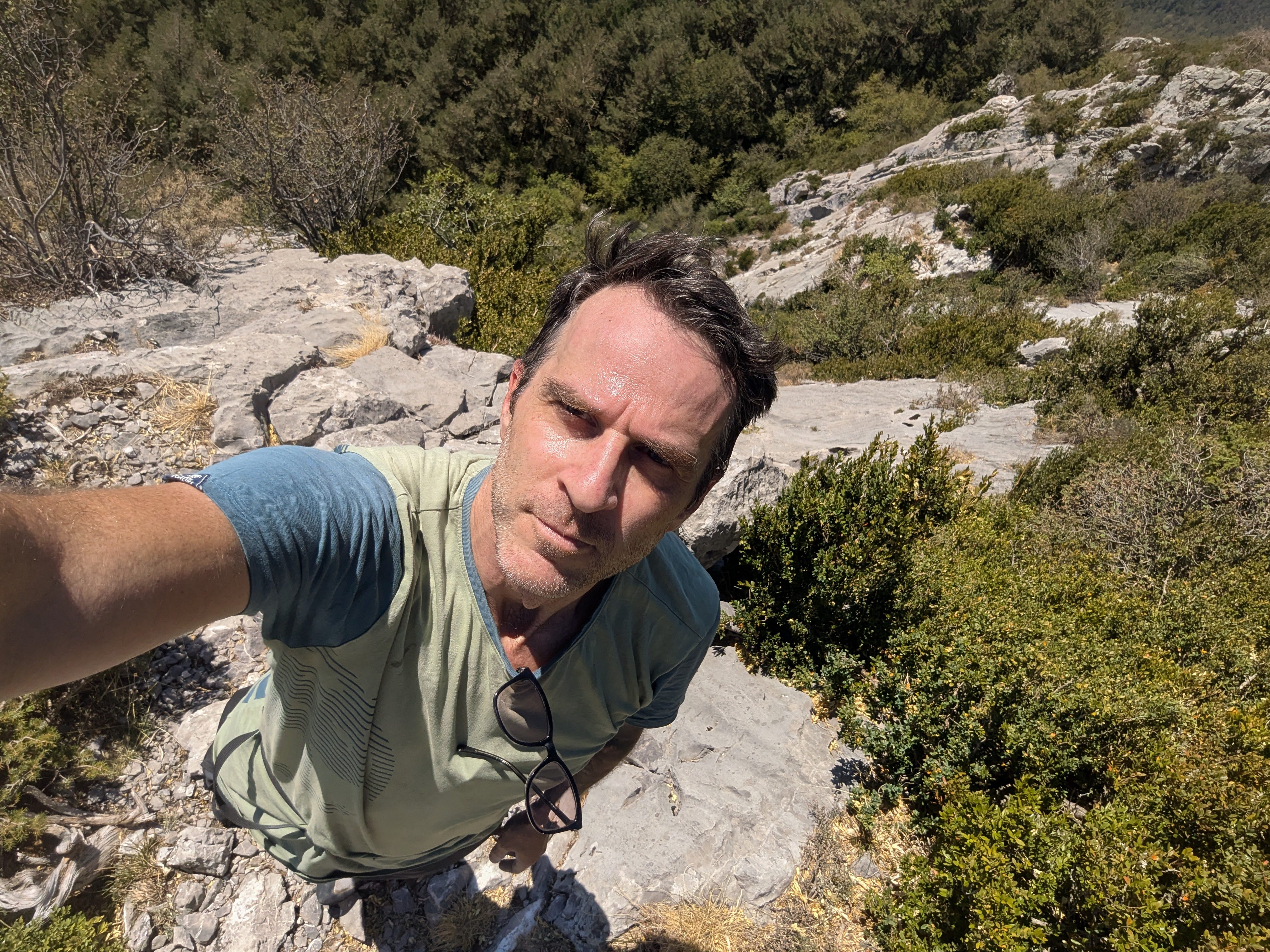
And then I snap a photo. It’s a perfect day.
This was fantastically written. Bravo. I struggle with all the same.
Really really enjoyed this piece - the tension is palpable.
Mark Sundeen's other books (Delusions + Grandeur, The Unsettlers) are also great. I enjoyed The Man Who Quit Money but felt a bit turned off when I read his personal blog. The Happiest Man in the World, about the man known as Papa Neutrino, is another you might enjoy. And thanks for bringing Catching Pinecones to my attention, even if I'm frustrated I can't (yet) watch it.