

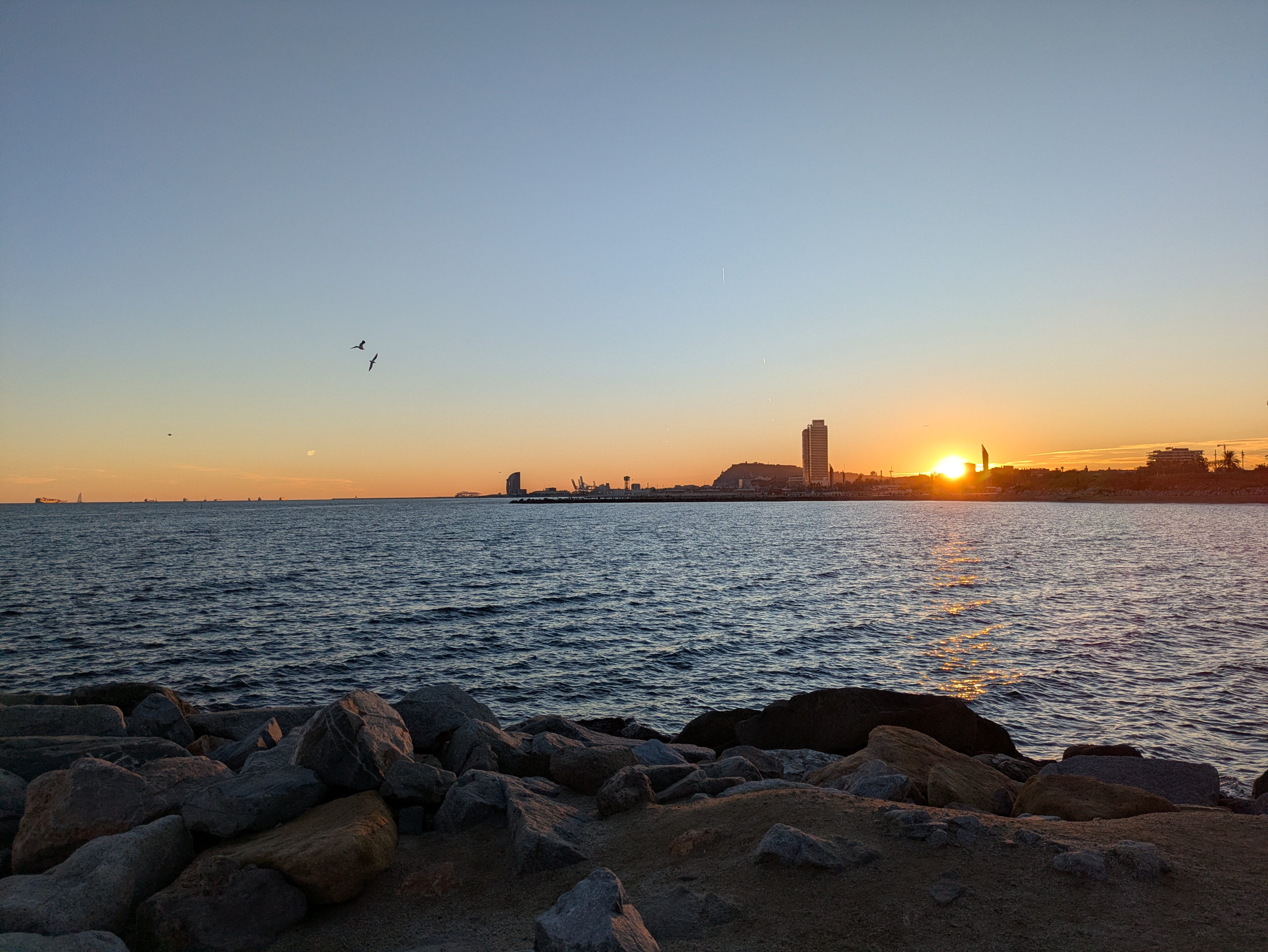
I get the sense that everything is unravelling beneath us—the fabric that holds civilization and our own mental sanity together. And yet, congizant that previous generations have always thought that, I wonder if I’m not just growing crotchety and old.
Or maybe my own creative work is at a crossroads. “Where’s the room for the creative expression, where’s the room to experiment?” said Kyla Scanlon recently in an interview with Derek Thompson:
I’ve been doing social media for almost four years now, and I’ve definitely noticed the algorithms are closing in on us, there’s less and less room, there’s less and less air to experiment, to be creative, because everything is so mathematically driven. It’s all about views and retention.
Yesterday, I deactivated my Instagram account and deleted Substack’s Notes app from my phone. Not that I ever used it, but the LinkedIn app also got deleted. Anything that swipes or scrolls or has feedback loops designed to give me dopamine hits of creative validation. I wrote the other day that reclaiming our attention is the most revolutionary thing we can do right now—but also maybe I’m just entering my Luddite phase.
My instincts are usually to stop playing games that I don’t like, and I’ve never liked the attention game. I do marketing for a living, but I’ve drawn the line at refusing to manage social media accounts. Plus, I’ve nearly worked myself out of having to work. Meanwhile, I’ve just sold a property in the U.S. for more than double what I paid six years ago, with no particular use for the cash other than to invest it in something very boring and income-generating.
I’m mindful that the premise of those investments is that society will keep on going more or less the same as it always has. Cities will not collapse, unable to pay their debts. Corporations will not suddenly find themselves illiquid. Governments will not borrow themselves into a full-blown crisis.
At the same time, it now appears that nearly the entirety of the U.S. economy is being propped up by the magical thinking of AI companies—who really are promising something like magic: a future of unlimited intelligence in which all of humanity’s problems can be solved if we only throw enough compute at them. The valuations are premised on that magical thinking coming true.
So again, I have to wonder: am I just getting old and crotchety, or is it the entire rest of the world that’s jumped the shark (thus have wondered crotchety old men and women everywhere throughout all time)?
To quote Wikipedia:
The idiom "jumping the shark" means that a creative work or entity has evolved and reached a point in which it has exhausted its core intent and is introducing new ideas that are discordant with or an extreme exaggeration (caricature) of its original theme or purpose.
The entity I’m wondering about right now is the world itself. I’m not sure what the purpose of it is, or my own. My old suppositions about discovering and lifting up that which is most human in all of us seem quaint in a world where the most successful creator on the planet is arguably this man:
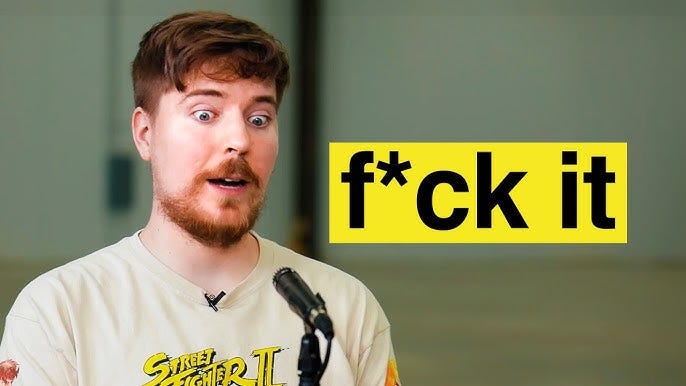
In the Scanlon interview, she quotes from Mr. Beast’s recent memo about how to succeed within his production company:
Your goal here is to make the best YOUTUBE videos possible. That’s the number one goal of this production company. It’s not to make the best produced videos. Not to make the funniest videos. Not to make the best looking videos. Not the highest quality videos. It’s to make the best YOUTUBE videos possible. Everything we want will come if we strive for that.
There it is: no more room for art of any kind. No more tension between creative work and commercial necessity. Just serving the algorithm. Is that not this generation’s siren call? Everything we want will come if we strive for that.
Perhaps by deactivating and deleting the socials, I’ll actually be able to opt out. Perhaps the whole world will gradually appear less driven by memes, and the quality of my own thinking will begin to recover. Maybe it won’t feel as if the algorithms are closing in on me.
Still, the creative work I’ve been doing is on hold. The screenplay and the deck for the television series I was hired to work on are paused—the producer still hasn’t found a buyer, and with limited budget, we’re all taking a breath to decide what the next move should be. I know she wants to sell this idea and see it come to life on a streaming platform somewhere near you. But I suspect the right move is probably to move on.
I heard recently that Netflix executives have advised their screenwriters to make their characters say the thing instead of showing the thing. This is the precise opposite of a generation’s worth of advice for young writers to show, not tell. The reason given is that Netflix knows its viewers are likely to have multiple screens open while they watch, so if their eyes are elsewhere, it’s important to deliver plot points in the form of actual dialogue.
So anyway, it seems we are all truly fucked.
Many might simply say this is what “late stage capitalism” looks like. I’m not sure, but to me it seems more like Jacques Barzun’s From Dawn to Decadence—a 900-page tour of Western cultural history in which civilizations follow a predictable, cyclical pattern: they produce great wonders, then they grow rich, then they become lazy and decadent, only to have periods of disruption and renewal. Today it seems that many wealthy societies all at once have become lazy and decadent. Lazy in their thinking, decadent in their habits.
Here in Barcelona (and in many cities across the Western world), it is universally agreed that there is a cost-of-living crisis, primarily driven by the affordability of housing. At the same time, the streets and cafes are always full, the people sitting for hours drinking their coffees and beers and vermuts. You pass table after table where sit dozens of empty Estrella bottles, and groups of friends crowded around laughing and conversing. The restaurants are always full, the parades well attended, the beaches packed, the mountains awash in hikers and climbers and bikers and runners with their dogs. If this is late state capitalism, it seems a lovely, natural end state to the world.
Unfortunately, as we all well know, it’s not the end—not yet. A period of disruption and renewal is on its way. Perhaps that’s what I’m feeling, when I feel the unravelling.
There will always be those who look at modernity and think "what have we become?" But that never changes the fact that we must always find meaning and a place in our world.
Retreating will never stop the progression of technology and culture.
Instead, we must look for what is positive, what gives us meaning and what options we have to adapt.
We must choose where we put our attention and what we allow to affect or influence us.
Times of turmoil = a time for opportunity; there is a historical precedent in that, too,, if you just choose to see it.
Personally, I applaud the café-goers; they know whats up. They are choosing meaningful, tangible relationships over algorithmic conditioning and endless scrolling.
Neru fiddled while Rome burned.
History repeats itself with all of us raising glasses in cafes.
We are well and truly fucked.