
Those little eternal problems of existence
In which I face challenges akin to a retired empty-nester

There’s a certain restlessness among people in the city.
They want to do everything because they can. But what they gain in abundance of choice, they suffer from in anxiety. One might say it’s the central problem of abundant, modern societies. All of us going around being told to self-actualize, to work on ourselves. And then what?
When we can go anywhere, do anything, and be anyone, we suddenly find ourselves confronting life’s most difficult questions about meaning and purpose. “Anxiety is the dizziness of freedom,” as Kierkegaard put it.
I wrote more than a year ago about the problems of too much freedom. It’s a recurring theme here, one that seems to have popped up yet again in the last few days.
Unbridled freedom doesn’t necessarily lead one to life satisfaction, I told my climber friend last week. I was visiting his place in the mountains, where conversation away from the rock often turned to politics.
People don’t want to be told what to do, he replied.
I think that’s exactly what a lot of people want, I countered.
We went back and forth over tea, with a view of the cliffs outside. He cited history, telling me that autocracies fail because they force people into lives they don’t choose for themselves. I cited Plato, suggesting that people might be happier with less choice if, in exchange, they could have more social connection.
He conceded that, unlike me, he didn’t study philosophy in grad school. I conceded that, unlike him, I hadn’t just published a book on political ideology.
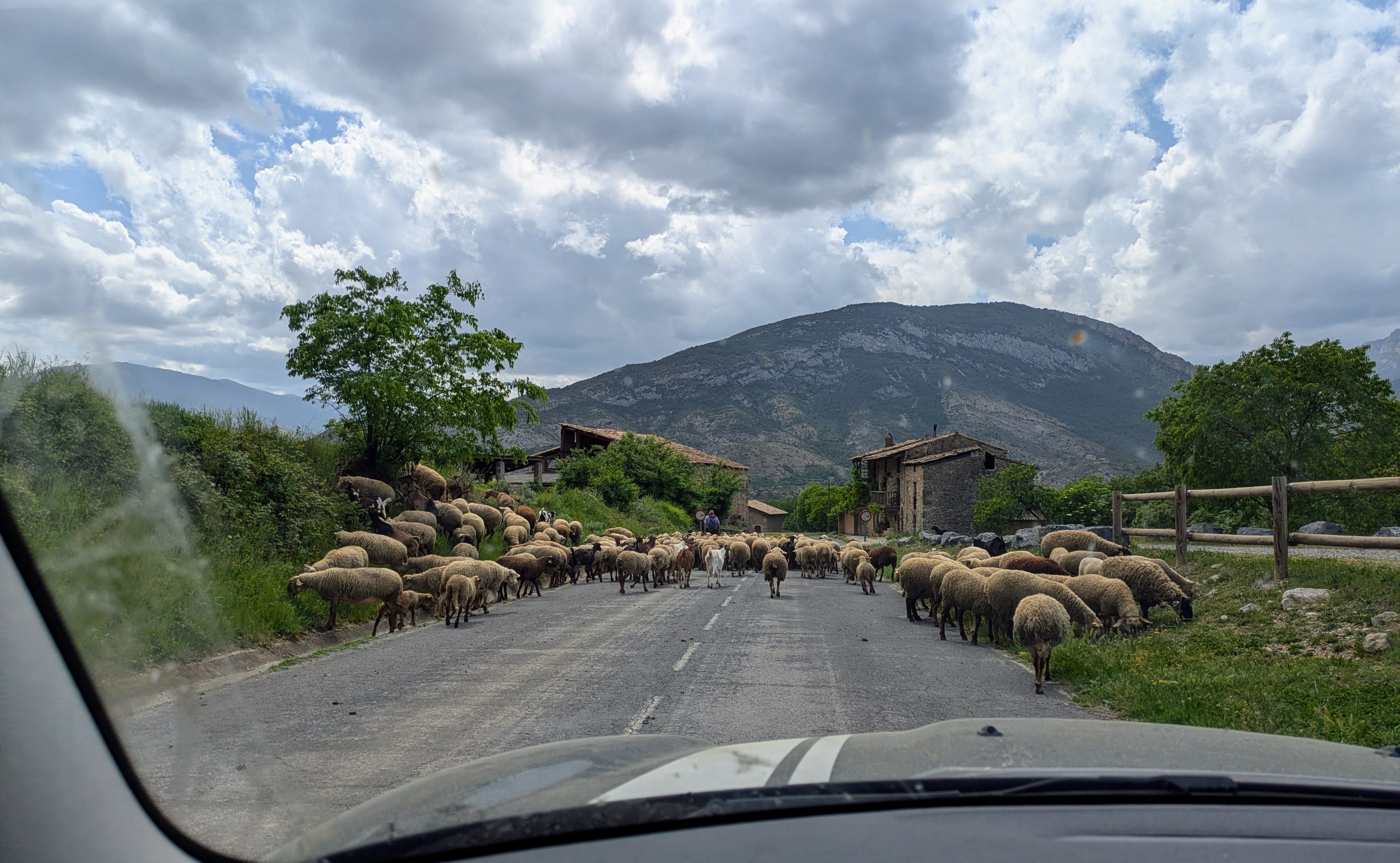
After breakfast, we drove to a crag he had bolted, one of the many visible from the gigantic glass sliding doors leading out from his living room. We walked from his truck up the gravel path to the cliffs. He pointed up at a beautiful overhanging 7b.
There are crazy acrobatic moves at the top, he says.
Sounds cool, let’s do it.
We both sent on our second attempt. Six months ago, a climb that hard would have taken me a week at least. I’m hitting my stride, finally. But I’m not sure how much more time I want to devote to climbing now that the season here is effectively over. Basically, I have too much time on my hands and can’t decide what to focus on. I need more constraints.
I am faced with existential problems of purpose and meaning that are the clichés of retired people and empty nesters. Except I’m 44.
Back in Barcelona, I turn on a podcast: Derek Thompson interviewing David Epstein about his new book Inside the Box. They quote a psychologist named Mihaly Csikszentmihalyi, who notes that married people with kids report the greatest levels of happiness, despite, in many ways, having the most constraints on their lives:
By making up one’s mind to invest psychic energy in a marriage, regardless of any problems, obstacles, or more attractive options that may come along later, one is freed of the constant pressure of trying to maximize emotional returns. Having made the commitment and having made it willingly, instead of being compelled by tradition, a person no longer needs to worry whether she has made the right choice or whether the grass might be greener somewhere else. As a result, a great deal of energy gets freed up for living instead of being spent on wondering about how to live.
The actor Bob Odenkirk expressed a similar sentiment in a recent interview with the comedian Mike Birbiglia:
There’s no question I knew what I was doing when I had kids growing up. I was being a dad. That was my job. And I didn’t have to ask myself ‘what am i doing here?’ How can I be a part of this world? How can I be meaningful today?’ I didn’t have to ask that question, because the answer is ‘pick up everything between here and the door, and make sure they get to school, and have a laugh with them.’ Life was, you know—I understood my purpose.
I must admit, I wasn’t quite as clear on purpose when my son was younger. But I see the point, clear as day.
The more constraints we have, the more we can focus on just doing the thing. And the social science is clear: more options equals more likelihood of being unsatisfied with the choices we make, and more anxiety about where we made the wrong choice. This goes for our careers and our romantic partners, as well as the smaller questions, like what food we buy at the grocery store.
Conversely, as Epstein writes, constraint often generates invention, creativity, and breakthrough.
Of course, I’ve understood this for quite a long time. When I was making indie films in Washington D.C., I took the low budgets as a challenge to find creative production solutions, as directors have done from time immemorial (It’s not cool to sit around complaining no one will give you your budget; cool is making the best film you can on the budget you have).
And, I’ve been writing about this here since at least 2022.
Last year, I set a goal of dramatically simplifying my life. A smashing success, but that has led to new challenges. Even fewer constraints. Fewer demands on my time. I must resist simply filling it back up with random obligations, which is what many of my fellow city dwellers seem to do. Busy schedules are still somehow like status symbols here, as they are in the States. Tuesday group meditation; Wednesday swing class; Thursday pottery. Next four weekends, planned in advance.
Nearly all their time is spoken for (if they haven’t achieved this by adding hobbies, their work has likely done it for them), and so most are not obsessing as I do about meaning and purpose. Their energy is devoted to living, as opposed to wondering how to live.
Limitations are liberating, I know that. But what more limitations should I impose on myself? I already brought my dog from the U.S. This is the most structure I have right now: a morning pee, a longer afternoon walk, and one more outing around the neighborhood to sniff the lamposts before bed.
A week ago, I posted an image from Agnes Callard’s Open Socrates to Notes. It was about what she calls The Tolstoy Problem:
My question… was the very simple question that lies in the soul of every human being, from a silly child to the wisest sage—the question without which life is impossible, as I experienced in actual fact. The question is this: what will come from what I do and from I will do tomorrow—what will come from my whole life?
The question did knock me for a loop there for about 24 hours. But I soon got over it. In times like these, the Zen proverb has given me a lot of solace: Before enlightenment, chop wood, carry water. After enlightenment, chop wood, carry water.
I take this to mean that we continue on with our lives no matter how much ‘meaning’ or ‘purpose’ we do or don’t find—whether that is going to our jobs, toiling away at a book, or climbing a rock face. No amount of enlightenment will free us from the basic realities of existence.
Later, Tolstoy explains what he did in response to his problem:
And I searched for explanations of my questions in all the branches of knowledge the human beings have acquired… I didn’t search limply but I search agonizingly, persistently, day and night; I searched as a dying man searches for salvation, and I found nothing.
I don’t have the patience to search that hard, and definitely not if I’ll still just be left chopping wood and carrying water. So, after I hit ‘publish’ on this piece, I’ll try not to spend too much more time lamenting or worrying about it. Too much freedom is a fine first-world problem to have, I know.
You need to check your privilege, bro!, another climber friend would often joke to me. Yea, he and me both: each of us self-employed, with near-full control over our schedules, climbing through the winter, enjoying the freedom of the mountains, the joy of movement on the rock, the lively conversation over wine in the evenings, shooting pool on his billiard table.
Not to say I don’t appreciate it when someone validates my existential struggles as legitimate. And I get a certain satisfaction over the popularity of a movie like, say, Sentimental Value, in which wealthy, socialist Norwegians with all their material wants long ago fulfilled nevertheless continue to agonize over existential problems of purpose and creative fulfillment.
But in the meantime, we must try not to obsess too much over those little eternal problems of existence.
Thinking about the first portion of your post mostly, was waiting for quotes from The Grand Inquisitor poem in The Brothers Karamazov, when Jesus comes back to earth but is imprisoned by the Grand Inquisitor. That humanity can’t tolerate freedom and needs constraints with the illusion of freedom in order to not suffer. I still think about this book frequently almost 30 years after reading it.
There probably is never the right balance of autonomy and constraints. Coming to terms with that is probably futile as well.