


I was gonna say: you should go climbing.
We were naked in bed, my girlfriend and I, and talking, as we often have, about mental health. Her struggles, my struggles, the world’s struggles. It was a warm afternoon in June. My double windows swung open to the back terrace to let in the Mediterranean city air.
She had just been to therapy, and me, I had just been outside climbing.
Why? she asked in return.
I took a long pause. There was something I’ve been trying to say for a long time about climbing, something that has been germinating in my writing for years, but was only recently clarified. It’s not like I haven’t already said a hundred times that climbing is my therapy—but there was more.
What I needed to do was write an entire post just about the mental health part. Because, dear reader, this applies to all of you.
I fear that as a species, as a global community, as a civilization, you might say, we have collectively lost touch with reality. And I believe climbing—specifically, projecting climbs outdoors (I’ll explain “projecting” in a moment)—may offer a lesson to help us find the way back to something resembling a functioning polity. A way back to a shared understanding of reality.
Not that society is going to collectively take up rock climbing and thereby resolve all its ills. But walk with me just a bit.
I.
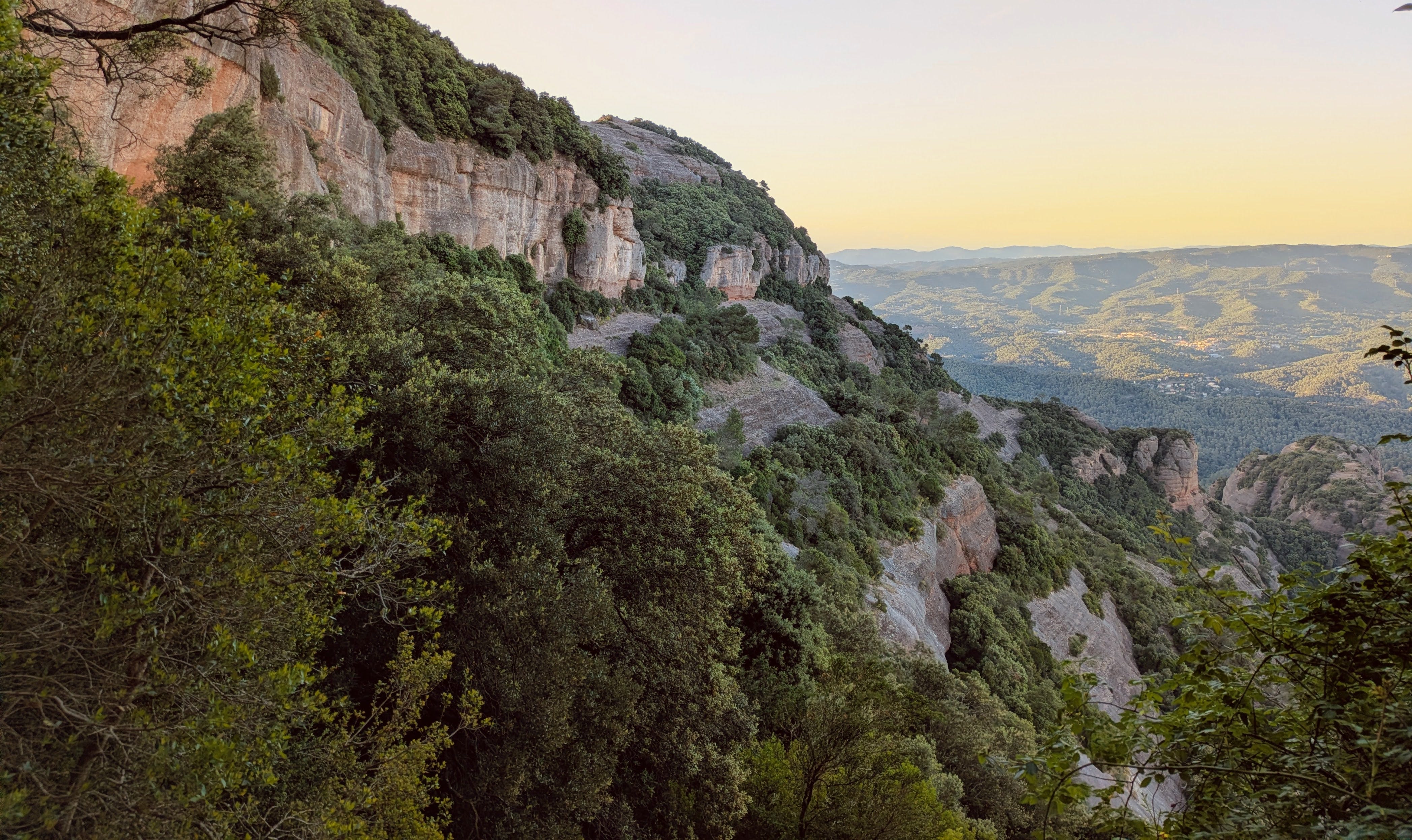
Starting sometime at the end of April, beginning of May, it simply becomes too hot to climb in the sun here in Catalunya. You have to chase shade.
So it was that a small crew and I drove 45 minutes north from Barcelona toward Sant Llorenç del Munt. I had been twice before, but years ago, when I first moved to Barcelona. The rock is conglomerate, like the famous otherworldly nearby spires of Montserrat. Little pebbles, baseball-sized rocks, and the myriad detritus of geology baked into millions of years of sandstone. It looks cumbly, but it is surprisingly solid. You can rest your whole weight on a grape-sized pebble protruding from sandstone, and it will hold.
Of course, the rocks do sometimes fall out, leaving pockets that create new holds, the kind you have to feel around in to see how good they are. The routes that go up conglomerate cliffsides are notoriously difficult to “on-sight” (i.e., climb cleanly on your very first try, with no falls or resting on the rope), precisely because you can’t know how good a pocket is until you touch it.
After a 40-minute hike uphill, we came to the top of the mountain, and a trail that led around to what we were looking for: El Gruyére, a cliff that faces directly north, never getting an opportunity to soak up heat from the June sun. We dropped our packs, laden with 80-meter ropes, dozens of quickdraws, and copious liters of water, and basked in the cooler temps sheltered by the gently overhanging shaded cliffs.
We warmed up on a relatively easy route, then I led a flowy slab with an imposing crux move just before the chains at the top. After that, we turned our attention to the most interesting part of the cliff: a more overhanging, heavily pocketed 30-meter-tall section with a smattering of harder routes, ranging from 7a to 7b+.
Here is where we made measurable contact with reality.
II.
In fact, my girlfriend had just read one of my posts from last year, A breakup focused me like never before, about how I turned to climbing in the aftermath of my last relationship.
I’ve done that a few times in life. I’ve also been to therapy a few times. Once, a therapist urged me to get on antidepressants. I promised her I would go to the gym instead, and I did every day until I saw her next. I felt better, and the crisis passed. Over the years, I’ve learned that a few weeks devoted to a hard climb is better than any therapy I could seek.
That’s because climbing does something that therapy doesn’t. It puts me and my full body into contact with reality—real, physical, hard reality—in a way that no amount of cognitive interpretation or rumination or analysis can.
But it’s not just going climbing that does this. It’s devoting myself single-mindedly to just one hard climb for weeks. We call this projecting: going back over and over to the same very hard route in an attempt to work out the moves, master the sequences, and eventually “send,” i.e., climb the route in one go with no falls or resting on the rope.
Not all climbers enjoy projecting. But those who don’t, I think, are missing out on something important. Yes, projecting helps you improve as a climber, and by improving, it expands the range of climbs that are available to you. Getting better “expands the size of the playground,” I am fond of saying, and for that alone it’s worth it to try.
But the beautiful part of projecting is that finishing it—sending—is an incontrovertible measure of shared, objective reality. I wrote about this last year as I was projecting the hardest climb of my life:
…the beauty of projecting is that it defies your own narrative: you don’t have it until you have it. It’s not a subjective thing. It’s not in the mind of the beholder. You either send or you don’t send.
When it happens, we all know that it’s happened. And if not, not.
This is what I mean by measurable contact with reality (the operative word being "measurable").
So many things in life are indeed subjective. Things I care about deeply. Art, writing, film, politics, relationships. In so many areas of life, different people can look at the same facts and come to different conclusions, see different patterns.
Making sense of reality is harder than ever. It’s so hard, in fact, that our default response has been to create, or immerse ourselves, in bubbles of our own making. We accept individually tailored digital realities. We celebrate “felt experience” and “individual truth,” while we separate ourselves from those with different interpretations of reality than our own.
In such a world, I find it hard to understand how we could possibly hope for a shared understanding of anything, much less an accurate understanding of ourselves. Therapy itself is an exercise in creative interpretation of a certain fact pattern, for the purpose of self-knowledge. I’m not trying to take away from the good therapy can do—only to say that it can’t do what climbing does. It can’t do what I’m about to describe.
III.
The rock just is, I found myself saying, as my girlfriend lay beside me, harkening my mind back to the absurd I Heart Huckabees poem, delivered by an entirely earnest environmental activist played by Jason Schwartzman. (“You rock, rock. The rock just sits, and is.”).
I admitted I’m in my own head a lot. Even as I’ve come to understand my feelings quite well, I usually just take those feelings as information to give to the analytical, intellectual side of my brain. (“Now that I’ve identified and understood my feelings, how much importance should I now assign to them for the purposes of moving forward in life?”).
It can be exhausting, all this intellectual rumination.
Up in the shade at Sant Llorenç, I clipped the first two bolts and proceeded to the overhanging portion of a 7a, normally a grade I feel pretty comfortable on. The first move required deadpointing to a small three-finger crimp, and then doing an overhanging pull-up using only the three pads of my fingertips to reach a pocket. My core struggled to keep my hips into the rock instead of swinging out into the air.
After that, there were more hard moves. With the rock so steep, it was hard to see the holds, much less inside the pockets. After each hard section, I asked my belayer to “take” so I could rest on the rope, catch my breath, and work out the next moves. This is called “bolt to bolting,” and there’s no shame in it. It just means you’ve found yourself on something quite hard.
After two months of drinking cervezas in the plazas, my body wasn’t quite in the same shape it was this past winter. I didn’t have the power anymore to do these overhanging pull-ups. I didn’t have the endurance to link together several moves without asking for rests.
I was very far away from “sending.” It was nothing personal. The rock just is, asa it has always been, shifting and crumbling and reforming itself ever so slightly over the course of millions of years.
In one world, I could have just stopped there. In fact, I hear this approach from many of my climbing friends who don’t like to go back to the same routes they’ve already tried. “I’m just here to have fun,” they say. “It’s all about the experience.”
Which is fine, if you want to treat climbing as if you’re visiting a new country or trying out a new restaurant (both of which are experiences completely subject to interpretation, I might add). But they miss something profound. I might even argue that to not try to send is to avoid contact with reality.
Why would we do this? Many reasons.
The podcaster and climbing coach Kris Hampton has a rant about this:
…after carefully curating my Instagram feed to get rid of most of the moonboarding videos I've been left with hundreds of posts every day that are trying to sell me the same message: “it's the process that's important. It's not about success and failure it's only about days out with friends. Sending doesn't matter because I do it all for the journey.”
But it’s a mistake not to treat sending as an important part of the process:
We’re humans. Failure hurts. Pretending it doesn’t is a lie. We understand that we need those failures in order to continue learning. It’s the same with success. We need those wins not only to keep us afloat but also to learn what it is that we’re doing right.
It’s not that we only care about outcomes; it’s that if we don’t care about outcomes at all, we’re positioning ourselves for self-delusion.
On the other hand, if you pay attention (and climbing hard cliffs all but forces you to pay attention), you will see that a climb can reveal something true about yourself in a way that can’t be argued. Not by your climbing partner, or your romantic partner, your friends, or your family. It can’t be argued by a politician, not by an influencer online, and not by a therapist.
But it will only do this if you try to send. You will only make contact with reality if you can objectively measure it.
You either did the thing, or you didn’t do the thing.
IV.
I tried the overhanging 7a twice, struggling up both times. My climbing partner that day tried it three times. At the top, she fell again and again. Big, 15-foot whipping falls into thin air. Each time I caught her, and each time, she jug-hauled back up the rope to the same hard section as before, trying to find a way through.
This wasn’t about trying a climb once, taking lots of rests, hanging on the rope, finally getting to the top, being lowered, and congratulating oneself on a day well spent with friends in nature.
This was about facing one’s own weakness head-on, one’s own failures, about understanding the interaction between yourself and nature, your body and the world.
The next morning, I found this video on YouTube about why Japanese climbers are so dominant throughout the world. Spoiler: it has to do with their relationship with failure. In Western climbing gyms (as a European route-setter in the video testifies), they gradually soften the grades so that the climbers can feel better about themselves when they complete the routes, so that they feel good and keep their memberships to the gym. Thus, there is an inexorable trend toward easier and easier grading: about sheltering our egos from reality.
In contrast, the Japanese gyms and the Japanese route-setters keep the routes and the grades hard so that climbers become accustomed to failure, so that they develop an acceptance of reality. As the Japanese climbers in the video tell it, they come to appreciate and have gratitude for failures, and it drives them to do better. It’s all there in the ancient Eastern religions, and has been from the beginning.
The rock just is. Understand and accept reality, especially your own. But to do that, you have to make measurable contact with it in the first place. This is the path to enlightenment. Am I overselling climbing as a spiritual practice? A path toward better mental health? A civilizational tool with which we can recapture a shared understanding of ourselves and the world? I think not.
Your passion for climbing is inspiring and I love how you connect climbing lesson/insights to life itself (accepting what is, facing challenges etc).
I think there is an interesting space for discussion around this. Understanding that humans exist within a dichotomy of the emotional and abstract — and how time spent in the abstract comes at an emotional cost — is relevant.
Mental distress is often worsened by ruminating — on the past and potential future — which are both in the abstract; self-harm enables people who are suffering from mental distress to come back to their body/to feel some sort of connection to themselves. I have discussed this with a few people who have done a fair bit of self-harm, and it seems like it aligns. That, to some extent, aspects of mental distress are caused by a spiral away from 'the emotional' and into 'the abstract', where we can lose ourselves and find it hard to return.
If you are climbing — or other similar sports, I imagine — being in the abstract is difficult, as you are way too focused on the present, the reality you are up against, and your own fear/pain/effort that you are facing.