

Yes, I’ve been preaching finding meaning by staying in place—but staying in Barcelona through this kind of soaking hot Catalan summer is more suffering than sense-making.
Not that it hasn’t been event-filled.
There was the dramatic exit from this world of my girlfriend’s aunt, who set fire to the apartment before jumping from a sixth-floor balcony in Sant Antoni. Spain winning the World Cup, watched from a terrace on the beach in Barceloneta, and celebrated by nearly the entire city. The American Pope, passing up Via Laietana as we came out from a shibari performance in El Born, waving at me with his window down.
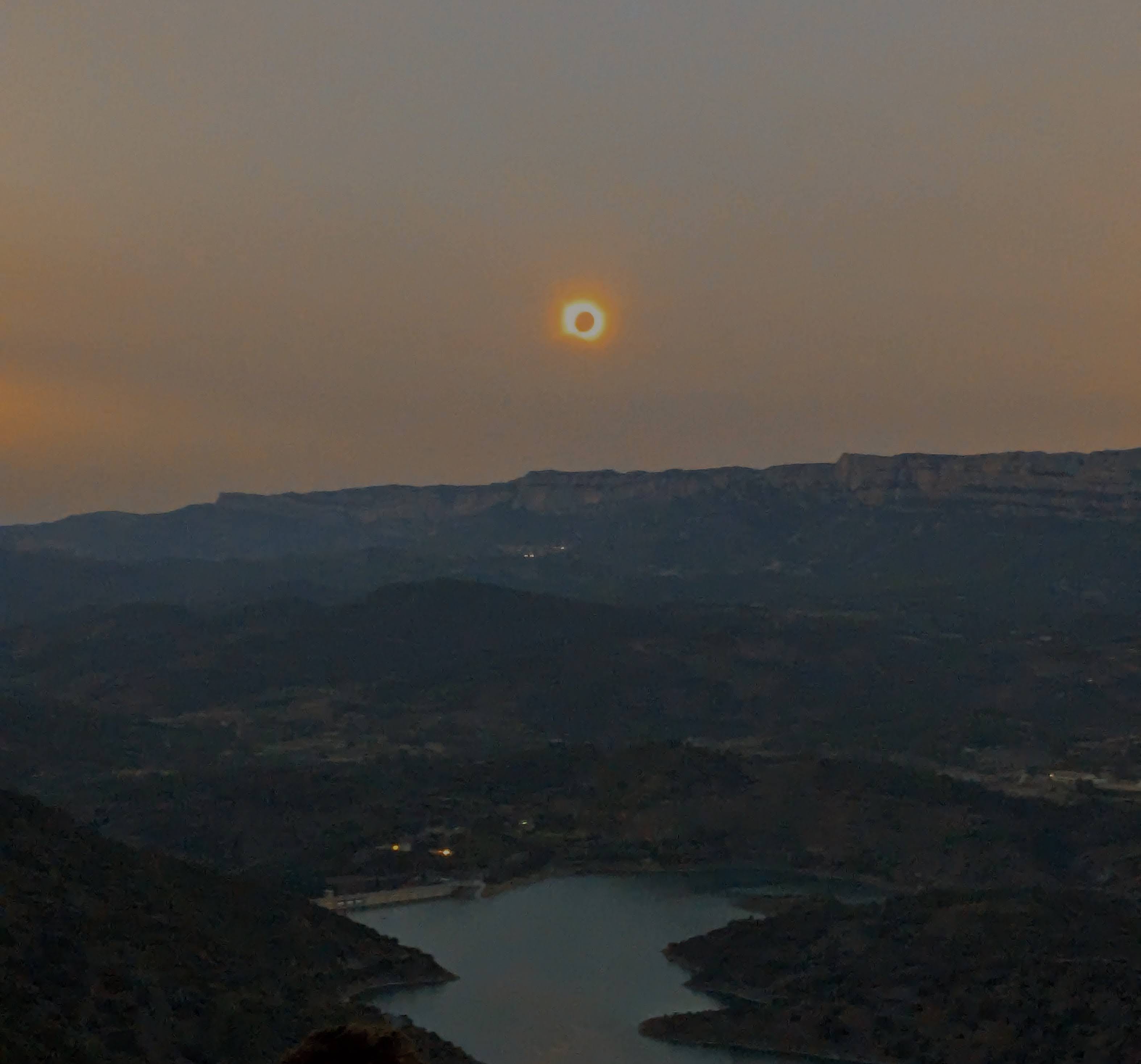
And then there was the once-in-a-generation solar eclipse, which just happened to pass directly overhead the climbing cliffs that first drew me here, directly above my old stone renovation project, against which I have been fighting a grinding war of attrition for the past three years.
We drove out from Barcelona, air con blasting, aiming for my friend’s house in Arbolí, a trip that usually takes two hours, stretching to three with traffic and long lines at the gas station. Everyone headed west, into the path of the totality.
The small mountain town is packed, cars lining the street. We meet friends from Barcelona. They’ve taken the train to Borges del Camp, then cycled up the long, windy hill into the mountains. In this heat. They drop their bags, shower, and we walk from town toward the cliffs of El Falco, where I know there will be an unobstructed view.
We sip vermut on the hillside, we take photos with our eclipse glasses. The cliffs of Montsant and the hilltop town of Siurana look surreal in a hazy fading light, as if sunset has come early. As if there were a dimmer on the entire Catalan countryside. We watch with a small group from a perch off the trail I have hiked down a dozen times.
It seemed—only for a moment— that the heat faded, so that we could enjoy the precious, brief moments of cosmological magic without sweat beading on our chests. God lowered the temperature just enough for us to contemplate his possible existence.
See? he was saying. I can still awe you. Awe and wonder at my creation are still possible.
Or rather: if I believed in him, that’s what I imagine he might be saying.
But then we return to the heat. Heat of our own making. Spain on track for its hottest Summer ever recorded. Forest fires outside Madrid making international news. Records shattered. Only hotter from here.
The heat is demoralizing. The words in my Spanish flashcards are telling: sofocante — the heat is suffocating.
The morning after the eclipse, I go to check on the renovation with the builder and the architects. He’s going to blow through his fourth self-imposed deadline of August 20th. The architects are doing their job, supervising the technical work, but their real job is to speak in words that the builder can understand that we expect this project to be finished, at long last.
I watch and listen as they switch to Catalan, then back to Spanish, for my benefit, and then to Catalan again as the conversation gets more heated. All I care about is that there are no more unexplained pausas. That the builder simply works until the job is done, rather than doing as he has done for the past ten months, going back and forth between this and other priorities.
And then we return to Barcelona. Indeed: what have I been doing here stuck all Summer in the city? It’s not like I haven’t already written that all who are wise who live here leave the city in August. Yet I am here: not climbing, not going out much. Just sheltering in place in the air con in my home office.
The fourth heatwave of the Summer is upon us (or is it the fifth?).
My capacity for patience and thoughtfulness is noticeably diminished. My girlfriend mentions again how hard the heat is on her. She’s a child of the Mediterranean; human survival and flourishing here was only ever meant to be experienced between a narrow band of perfect weather, moderate and sunny year-round with occasional rain in the wintertime.
Even in the climbing gym, the effects are felt. The large metal ducts through which the cool air is blown into the cavernous space only cover the bottom 80 percent. But this is a climbing gym; every route ascends toward a threshold above which the cool air doesn’t blow. So just as you’re pumped and making the last hard moves to the top, sauna conditions set in.
It’s the same in the metro: air con in the subway cars themselves, but underground the heat has sunk and settled onto the platforms. At Passeig de Gracia, a long, low-ceilinged tunnel connects two lines, and as I walk between them I think there should be EMTs on call, in case people pass out from the heat.
In certain moments I think I should be passing my days on the beach, swimming in the ocean. And indeed, I would like to swim in the ocean. One weekend I drive to a small cove with cliffs overhanging the water—this is deep water solo in English, or psicobloc in Castellano: climbing on cliffs above the ocean without a rope. It’s scary and exhilarating, even if the climbing itself is easy. Falling into the ocean after missing a move is quite nice. If it were directly outside my apartment, I would climb and fall and dip in the ocean five times a day.
But the bus to the beach just to dip once and sit under the sun seems like too far of a stretch most days. So I work, and write, and dream of lower temperatures. The climbing trips I’ll take, the nightlife I’ll enjoy, the beautiful Barcelona streets we will all reclaim.
When the temperatures drop, perhaps then I’ll understand better the meaning of it all.