
Vibe coding as the bombs fall
Welcome to the very beautiful late stage capitalist hellscape of wonder and possibility

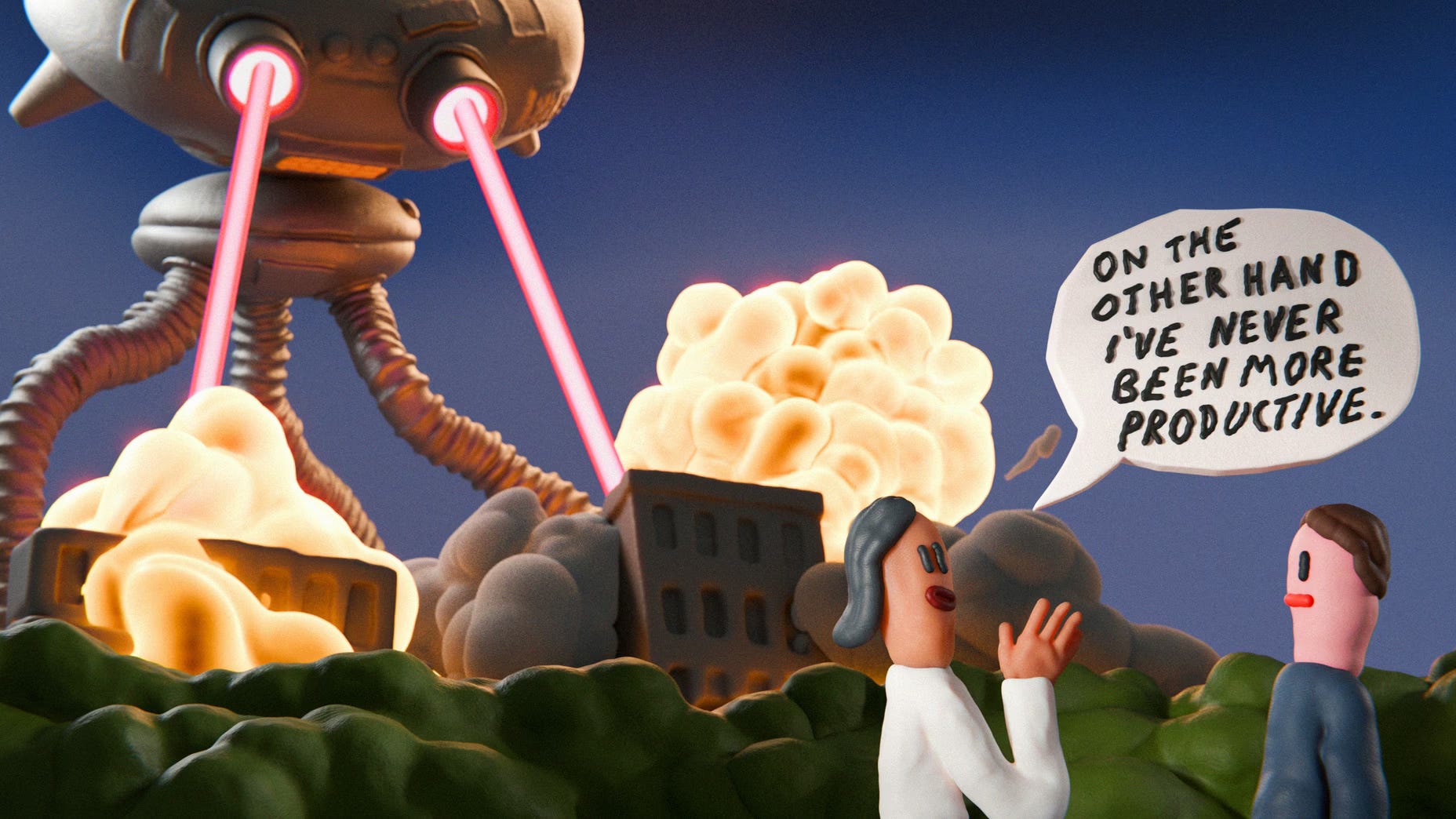
I’ve been thinking a lot about this illustration by Stephan Dybus in The Atlantic:
I was especially thinking about it as I sat at my desk a few days ago, trying to see if I could avoid the more mundane aspects of my consulting practice so as to free up more time to go climbing.
In one window, I opened a chat and asked my AI to teach me how to use Claude Code. In another window, as instructed, I opened my computer’s Terminal application. It looked like a DOS prompt window from when I was 12 and my parents were both computer consultants, which was also the last time I’d stared at a blinking cursor on a black background.
My step-dad had tried to teach me to code back then, but it never stuck. My thing was writing actual words, in English. Learning a foreign language was already hard, and coding seemed like a foreign language beyond my grasp. Not only did humans not speak it, but it demanded 100% accuracy to work. I’ve still never coded anything in my life. I’ve never even tried.
For three hours, I went back and forth. In one window, I asked Claude about the mysterious lines of code being written by some alien intelligence in the other window. The intelligence seemed to want to correct itself, and at times even add on. It occasionally did things I’d not asked for, announcing them after the fact as if it were giving me an FYI. Eventually, I stopped asking the chat window what it all meant and started typing commands straight to the alien.
Around lunch time, the program still wasn’t doing exactly the thing I wanted, and my stomach was growling. I was nearing the end of my attention for such things. I tweaked one last thing and hit Enter on yet another execute command, not expecting much.
And suddenly: magic.
I hit refresh on the backend of my client’s website and stared in disbelief at what the alien had just done for me. I won’t belabor it by explaining the functionality, but it was something so mundane and small that, of course, no software anywhere existed to do it, because it was just too custom, too specific to my client, to their site, and to my workflow.
My eyes went wide, my jaw dropped, and I started cursing: HOLY FUCK!! I had involuntarily jumped up from my chair in my office and started pacing my home office. My dog turned its head from the sofa in the other room to see the commotion. My hands went to my hair and literally started tugging. I said it again: Holy Fuck. I just couldn’t take my eyes off the screen.
I really did feel like a goddamn magician.
After a few moments, I sat back down in my chair, grabbed 16 files instead of one, dropped them into the Claude Code folder, and ran the same command again. Woosh, poof, kazaam. I had vibe-coded my first ever piece of software—and it was glorious indeed.
I.
The past few weeks, several of my Substack-writing friends have published their own kind of Come to Jesus posts about AI.Paul Millerd wrote that Claude Code has changed him. Nathaniel Drew wrote that he could feel the ground shaking:
It is dawning on me that the world that I knew as a kid is well and truly gone. And it’s a world that felt sacred, somehow… We’re entering a new age, an age of computer sorcery, where the time it used to take to make things is mindbendingly compressed.
Nathaniel is grieving for an old world that no longer exists, and so am I. But not only because 1s and 0s have now arranged themselves into a magical superintelligence. Also, because the country of my birth has fundamentally changed, and the ideas it once claimed to have stood for have been summarily executed. Taken out back, shot dead in the head, and buried without a funeral.
I’ve been grieving for those ideas. Few here in Barcelona can appreciate that. Even when our actions didn’t live up to the ideals, at least there was a dream. Now there is no more dream, and more bombs are falling, and not even the ones dropping them can say why. The possibility of a runaway AI intelligence launching a Skynet-like robot apocalypse appears to have receded for the time being. But the possibility of an entirely human-made war in the Middle East leading to a Biblical-style four horsemen of the apocalypse situation seems to have simultaneously risen.
Here in Barcelona, protests continue against and for everything—Israel and Palestine, women’s rights and the hard right, immigrants and tourists, renters and capitalists—and all the while we sip our afternoon Vermuts and escape to the mountains for the weekend.
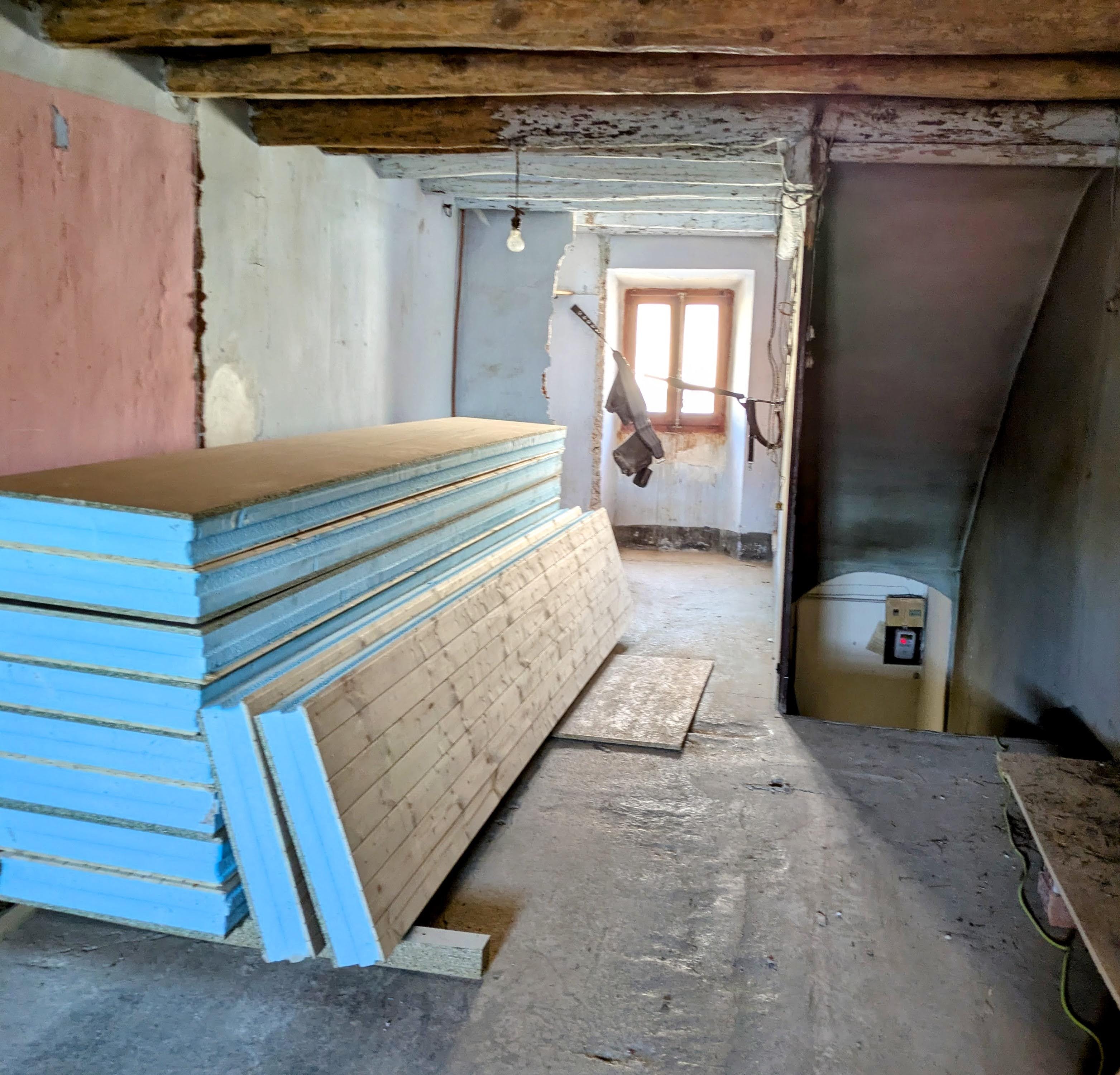
Last week, I managed to escape to the mountains for four straight days. I was there to climb but also to visit my renovation property, which remains a dusty, neglected construction zone.
I needed to have a difficult conversation with the builder I’ve hired to help move the project forward. Months have passed, and little has been done. There is no magic AI wand to wave that will get this all done—only real-world barriers to overcome. The builder did have some valid reasons for the delay: a death in the family; supply delays; the rainiest January in a quarter century. But many weeks had now passed with beautiful weather and no obvious holdups, and still, for some reason obscure to me, no work done.
I wanted to finally see him face-to-face and come to some kind of new agreement about the timeline. We meet on a Saturday morning. Talk on the second level of my property, where he was supposed to have poured a new layer of reinforcing lightweight concrete over rebar four months earlier. Go to the top level and dance around why exactly the roof replacement has not been started. He gifts me a gigantic jug of unfiltered olive oil from his family’s land nearby.
I know he’s a good man and well-intentioned. That much is unquestionable if you’ve spoken to him as much as I have. He looks me in the eyes and tells me that he too wants to see me enjoying the new rooftop terrace he was hired to build, a view of the cliffs at Montsant in the distance. I wonder if I’ve been too hard on him during the conversation. Or if I should have been harder.
Yo creo cuando lo vea, I say—I’ll believe it when I see it.
II.
Last month, news about Claude Code caused stock in software companies to plummet: they collectively lost approximately $15 billion in market capitalization in a single day of trading. We’ve invented superintelligent AI agents that can do all my tedious marketing work for me—but we still can’t build enough homes to save our lives.
Spain’s housing crisis has only gotten worse since the last time I wrote about it. A “Law on the Right to Housing” that introduced rent controls in the most distressed areas is backfiring in some significant ways. This has led to some awkward debates between me and the local anti-capitalists. It has also led property owners in the most in-demand areas to pull their homes out of the long-term rental market.
According to the governments in both Catalunya and Madrid, the law they passed is working: after all, rents have fallen. But anyone who has tried to find an apartment in Barcelona over the past year has found that there pretty much are none. Access to housing has gone down, which is the most predictable outcome of rent control ever.
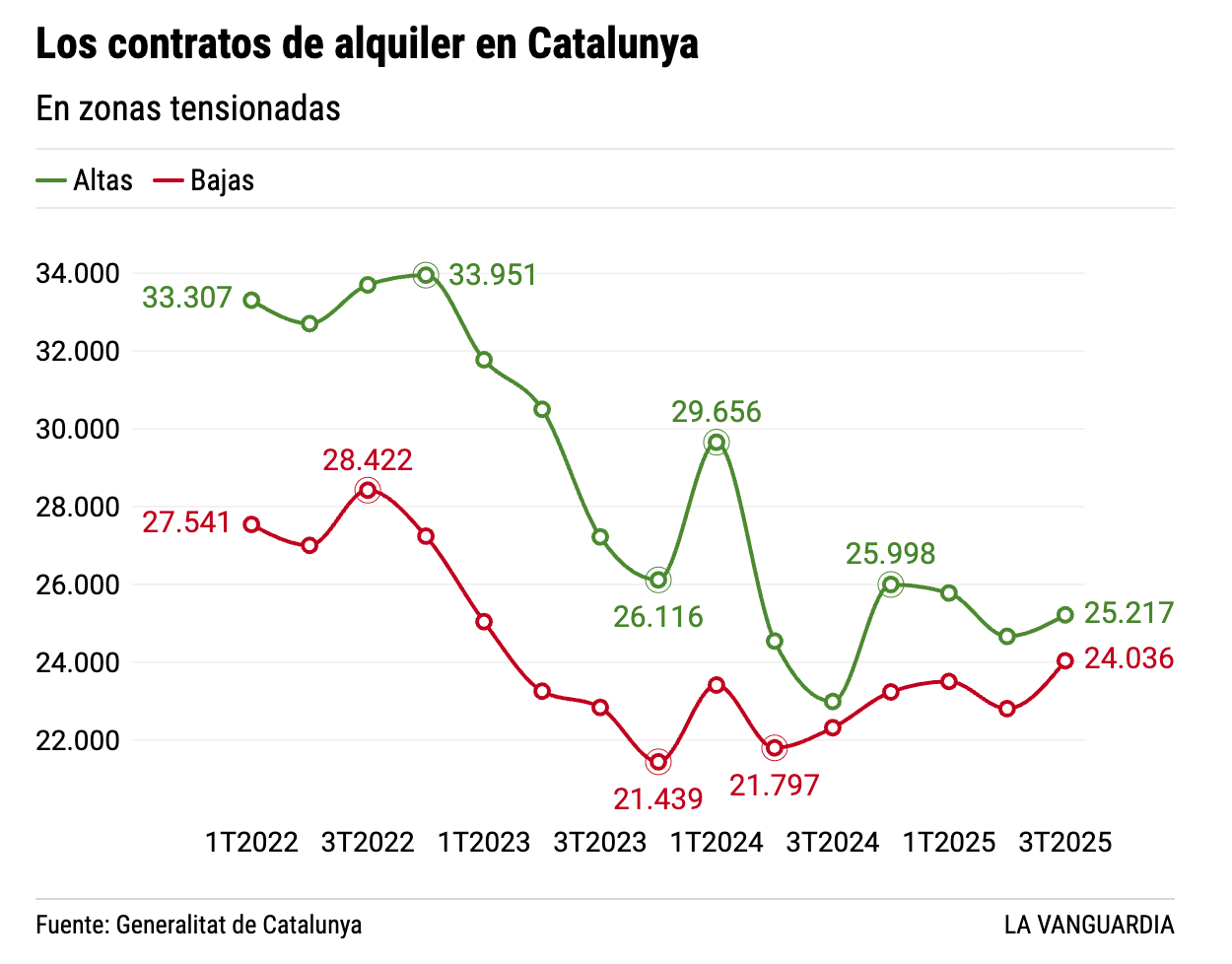
Idealista says the rental housing supply is now at historic lows. And as La Vanguardia recently reported:
…the feeling among the population is that accessing housing, especially rental housing, is becoming increasingly difficult. Housing has become the primary concern for the population…
But this is just one of the many Major Problems In the World right now.
I learned recently that when Christopher Columbus first discovered the New World, European intellectuals could hardly be bothered—there were simply too many other important things going on at the time. The Ottoman Turkish Empire was invading the east. A schism in the Church was brewing, which would lead to a 30-year war. Contests for control of various crowns were ongoing. The most consequential discovery on the planet at the time was relatively minor news.
We can never be sure which developments in our time are the most consequential, or which ideas are the most threatening. From the same podcast interview: of all the people put on trial by the Spanish Inquisition, thousands upon thousands were for practicing paganism in Catholic territory. Only one trial—Galileo’s—was for threatening church doctrine with actual science.
III.
I’ve let my AI robot rest for the day; it’s done enough to give me a few more hours to self-actualize than I was expecting this afternoon, and I start to contemplate a trip to the climbing gym.
But before that, I have a Zoom call with someone who has been reading through my recent Substack posts. “Do you know the famous Keynes essay from 1930?” they ask.
I did. In fact, I’ve got a Substack post about it that’s been sitting in my drafts folder for some time. The essay is called Economic Possibilities for Our Grandchildren. It predicts that future denizens of capitalism will have to work just 15 hours a week due to rises in productivity.
What Keynes failed to predict was that the more money most of us make, the more we want to make. Even despite abundant wealth, we remain financially-incentivized beings in our souls. From an NPR interview on the subject:
KESTENBAUM: In fact, he says, earning more money can make it harder to take time off. If someone is paid $200 an hour, do you really want to leave early and go to the beach? You’ll be sitting there on your towel, reading a novel, thinking, is this really worth $200 an hour ‘cause you could be back at the office. The better you are at your job, the harder it can be to not do it. It’s worth pointing out that Keynes himself seemed to have trouble following his own advice.
HUMPHREY: Maynard, of course, died from working too hard.
I have somehow escaped this trap, though it’s been a recurring conversation with my son since he was nine. He would always ask why I don’t work more, and I would always respond that I already have everything I need.
Not that Claude Code hasn’t given me pause: with so much power at my fingertips, my mind has started running a little wild with the possibilities. I could automate anything! Everything! The possibilities are endless. The ground is shaking. Claude Code has changed me.
After the Zoom call, I put my bag together for the gym and set out for one of the city bikes. The weather in Barcelona is increasingly beautiful as it shakes off the rainy winter, and I ride from my place in Poble Sec twenty minutes to the climbing gym at Tetuan.
It’s the middle of the day. Most people are at work. Only a handful of climbers have the time, freedom, and money to spend anything more than a bunch of weekends or perhaps a few short vacations throughout the year climbing outdoors. I have almost all the time I could want. The more I use the AI, the more time, freedom, and money I give myself.
I’ve never been more productive, I, as the character in Stephan Dybus’ graphic, say. And all the while in the background, the destruction continues—accelerates even. Old regimes are falling, incumbent economies are crumbling, and the ideas and ideologies that I grew up with are dead and buried, no longer defended.
We can build anything we want so long as it’s built with pixels—but what we really need is something different. New homes, obviously, but also new… everything.
I know I just wrote that I’ve made my peace with modern life, with “a certain bureaucratized decadence”—and I have. But a new world order appears to be coming, whether we like it or not.
Vibe‑coding as the bombs fall’ and haggling with a builder over lightweight concrete on a 250‑year‑old shell is such an elite mix of brains, ethics, and taste. Truly bravo.
The title captures 2026.